Kids' glasses: what actually matters (and what doesn't)
Children are hard on glasses, and they grow out of them faster than anyone expects. Here is what is worth paying attention to when you buy a pair for school, and what you can safely skip.
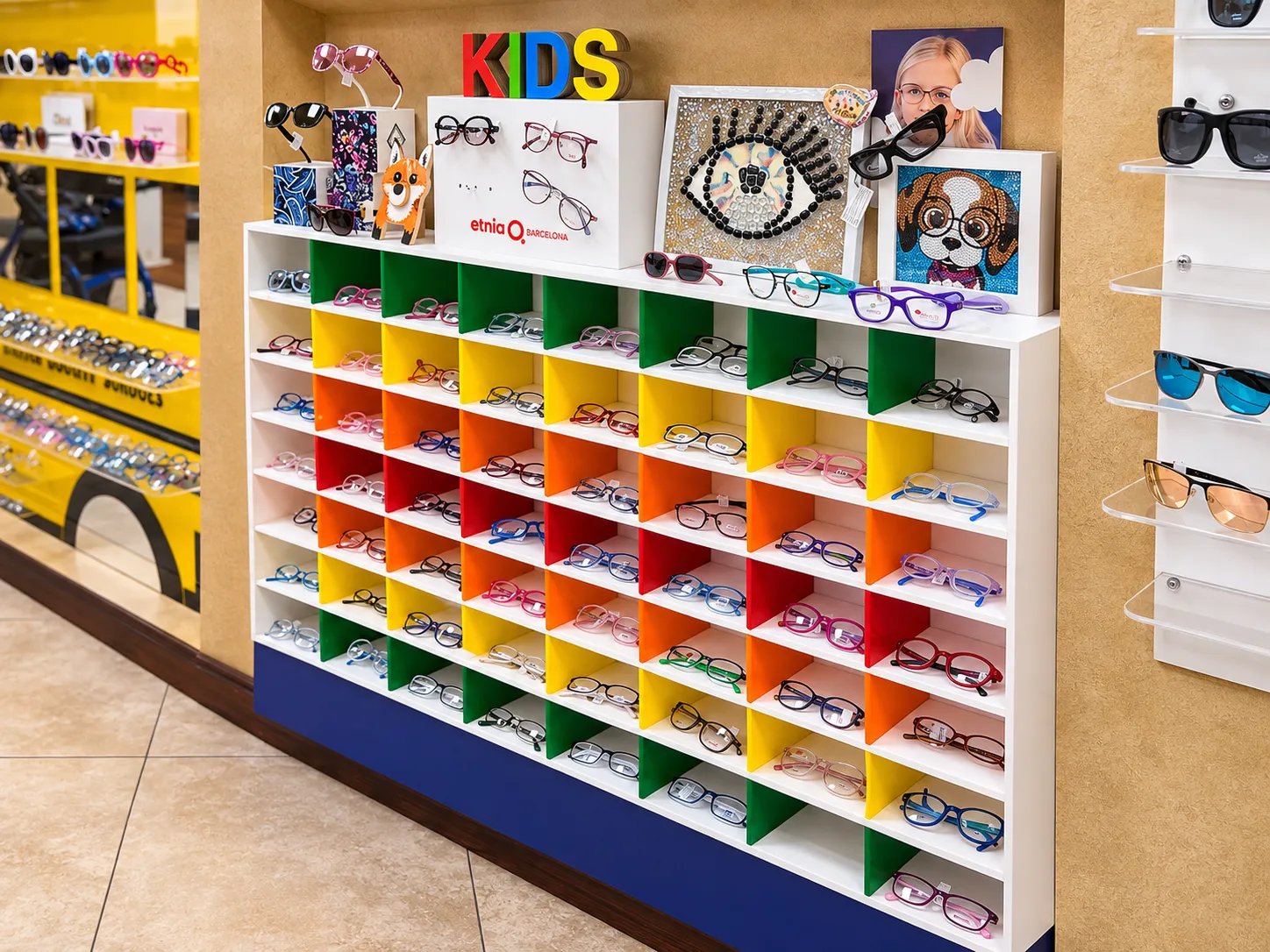
Every August the same scene plays out at our counter. A parent comes in with a list, a child comes in with opinions, and somewhere between the two is a pair of glasses that has to survive recess, the bus, a backpack and a school year. After fitting kids in Stuart since 1978, we can tell you the things that decide whether a pair lasts are not the things that are easiest to see on the wall.
Start with the eyes, not the frames
Glasses come after a prescription, and a prescription comes from an eye doctor. Schmidt’s is an optical shop. We fit and make glasses, but we do not examine eyes. If your child has not had an eye exam, or the last one was a while ago, that is the first stop. Eye exams are available in our building from SeeCoast Eye Care, an independent optometry practice. Call us at (772) 283-2622 and we will book it with them, or bring a prescription from any eye doctor you already use. We fill them all.
How do you know a child might need an exam? Kids rarely say “my vision is blurry,” because they have nothing to compare it to. The American Academy of Ophthalmology lists some quieter signs (opens in a new tab) to watch for: quickly losing interest in activities that need close eye work, losing their place when reading, turning their head to look at something in front of them, or one eye turning while the other looks straight ahead. The same page recommends vision screening in preschool, around ages 3 to 4, and again when a child enters elementary school. If anything on that list sounds familiar, talk to your pediatrician or an eye doctor. That is their call to make, not ours.
Fit beats fashion
Once there is a prescription, fit is the single biggest factor in whether a child actually wears the glasses. A frame that slides down the nose gets pushed up a hundred times a day, then gets taken off and left in a desk. A frame that pinches behind the ears gets “lost” on purpose.
A few things we check on every child:
- The bridge. Many kids have a lower, flatter nose bridge than adults, so a frame built for an adult face sits too low. Adjustable nose pads or a frame designed for a child’s bridge fixes this.
- The temples. The arms should reach past the ear and curve down behind it without digging in. For younger children and active kids, a cable or wraparound temple holds the frame on better.
- The size. The eyes should sit close to the center of each lens. A frame that is too wide for the face looks a little big now and works against the prescription.
Kids’ faces change quickly, so a frame that fit beautifully in August can be snug by spring. That is normal. Adjustments at Schmidt’s are free for as long as you own the frame, so bring the glasses back whenever they start sliding or pinching. A small tweak often buys months.
Lenses: polycarbonate is the sensible default
For children, the lens material matters more than almost anything else on the order. The American Academy of Ophthalmology’s advice on preventing children’s eye injuries (opens in a new tab) is to choose non-breakable frames and safety lenses made from polycarbonate, and it notes that polycarbonate lenses should be at least 2 millimeters thick for daily wear and 3 millimeters thick for sports.
Polycarbonate is also light, which helps with comfort on a small nose. It is the material we reach for first with kids, and it is the material included in our Student Special, below.
Sports need their own eyewear
This is the one that surprises parents. Everyday glasses are not sports protection, even with polycarbonate lenses. The Academy is direct about it: regular eyeglasses and sunglasses do not offer sufficient protection (opens in a new tab) from sports-related eye injuries, and they can shatter on impact. For baseball, basketball, soccer, racquet sports and similar activities, it recommends sports eye protectors made with polycarbonate lenses.
If your child plays a sport and wears glasses, ask about prescription sports eyewear, or about a protective frame that the prescription lenses can be fitted into. The Academy also recommends that children with good vision in only one eye wear protective eyewear, even if they do not otherwise need glasses. If that applies to your child, their eye doctor will want to talk it through with you.
Get a spare pair
Glasses get sat on, stepped on, left at a friend’s house and dropped in the pool. A spare pair turns a lost pair from an emergency into an inconvenience. It also means a child is not without glasses for a school day while a replacement is made.
The spare does not need to match the first pair. It can be the simplest frame on the wall. What matters is that it is current: when the prescription changes, update both pairs, or the spare becomes a pair that gives headaches.
What you can skip
You do not need a designer frame for a seven-year-old. A child who loves the color will wear a modest frame happily, and a child who is going to outgrow it in a year does not need the most expensive option in the store. We carry kids’ frames at a range of prices, and we will happily point you to the plain, sturdy ones. That is often the right answer.
You also do not need to buy every coating on the menu. Talk to the optician about how your child uses their glasses, and add only what earns its place.
The Student Special
For ages infant to 18, Schmidt’s Student Special includes free single vision polycarbonate lenses with any frame purchase, and frames start at $19. You can see the details, and anything else that is currently on, on our current offers page.
Back-to-school checklist
- An up-to-date prescription from an eye doctor
- A frame that fits the bridge and stays behind the ears
- Polycarbonate lenses
- Sports eyewear if they play
- A spare pair on the same prescription
- A free adjustment whenever they start to slide
If you have questions, call (772) 283-2622 and ask for an optician, or just bring your child in. Let them try on a few. A child who picked the frame is more likely to wear it.