Buying glasses online vs in person: when each one makes sense
The answer
Online is a reasonable choice for a simple, low single-vision prescription, a spare pair, or a frame you already know fits. In-person fitting matters most for progressives, strong prescriptions and children, because those depend on measurements taken on your face, like pupillary distance and fitting height, and on adjustments after you pick them up.
The honest answer is that it depends on your prescription, not on which option sounds more modern. Plenty of people order glasses online and are perfectly happy. Plenty of others order a pair, wear it for a week with a headache, and end up at a counter anyway. The difference is almost always predictable before you buy, and this guide walks through how to tell which group you are in.
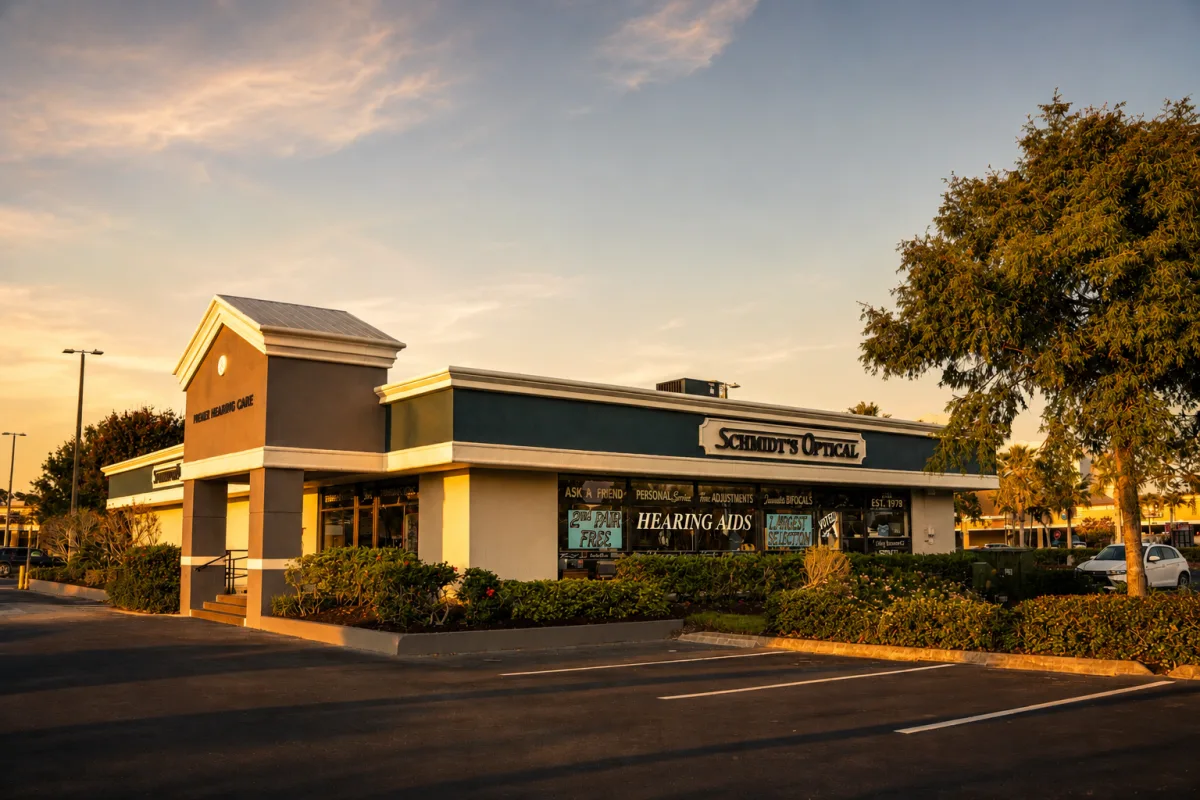
We are an optical shop, so weigh what follows with that in mind. We have tried to be straight about where online wins. For what we actually carry and how we fit it, see eyewear in Stuart.
Where online genuinely makes sense
If your prescription is a low single-vision correction, you have worn glasses for years without trouble, and you know which frame sizes suit you, ordering online is a reasonable choice. A low prescription is forgiving. Small errors in where the optical center lands in the lens make little practical difference when the lens has very little power, so the measurements that matter so much for stronger prescriptions matter much less for yours.
Online also makes sense for:
- A spare pair. A backup to keep in the car, the boat or the beach bag does not need to be perfect.
- A second pair in a frame you already own the same model of. If you know the fit, most of the guesswork is gone.
- Trying a bolder style cheaply. If you want to see whether you will actually wear a color or shape, a low-cost experiment is a sensible way to find out.
If that describes you, you do not need us for this pair, and we would rather say so. It is also worth knowing that a complete pair does not have to be expensive in person either. At Schmidt’s, single-vision complete pairs start at $28 on a selected range of frames, so compare the total, including lenses, before assuming online is cheaper. Details are on current offers.
What an online order cannot measure
A prescription tells a lab what power to grind. It does not tell the lab where on the lens to put that power, how the frame sits on your face, or how high your eyes are in it. Those come from measurements, and two of them do most of the work.
Pupillary distance (PD) is the distance between your pupils. It positions the optical center of each lens in front of each eye. Many people’s eyes are not perfectly symmetrical about the nose, which is why opticians often measure PD per eye rather than as one number. PD is not always written on a prescription, and a home measurement with a ruler and a mirror is easy to get slightly wrong.
Fitting height is how far up the lens your pupil sits when the frame is on your face and adjusted. It depends on the specific frame, the nose pads or bridge, and how the frame is adjusted to you, so it cannot be measured until the frame exists and is on your head. For single-vision lenses in a low prescription it matters little. For progressives it is critical.
Those two numbers, plus how the frame tilts and how far it sits from your eye, are why the same prescription can feel right in one pair and wrong in another.
Progressives: the clearest case for in person
A progressive lens has a narrow corridor that runs from distance at the top to reading at the bottom. Your eye has to line up with that corridor. If the fitting height is off, the reading zone ends up too high or too low, and you find yourself tipping your head back to read or ducking to see across the room. Many complaints that sound like “I cannot get used to progressives” turn out to be a fitting problem rather than an adaptation problem.
That measurement needs the actual frame, on your face, adjusted the way you will wear it. It is the one thing a website struggles to do well, and the cost of getting it wrong is a pair you do not want to wear. If you need progressives, have them fit in person. We go into what drives progressive pricing in progressive lenses: what you are actually paying for.
Strong prescriptions
As lens power goes up, precision starts to matter much more. In a strong lens, an optical center placed a little away from where your eye looks through it produces an unwanted prismatic effect, which some people feel as eye strain or a pulling sensation. Strong lenses are also where frame choice, lens material and lens shape decide whether the edges are thick and heavy or reasonable. An optician can steer you to a frame size that keeps the lenses thinner and lighter, something that is hard to judge from a product photo. How to choose frames for your face and your prescription covers this in more detail.
Kids
Children are the other case where in person is usually worth it. Their faces are still growing, their bridges are often low and flat, which many adult-sized frames do not suit, and their glasses take a beating. A frame that slides down a child’s nose gets looked over rather than through. Kids’ glasses also need frequent small adjustments as they are bent, sat on and dropped.
Lens material matters too. Polycarbonate is an impact-resistant lens material and a common choice for children. At Schmidt’s, the Student Special covers ages infant to 18 with free single-vision polycarbonate lenses with any frame purchase, and frames from $19.
The part after you pick them up
Glasses are not finished when the lenses go in. Frames loosen, temples spread, and nose pads shift. A small adjustment can be the difference between glasses that stay put and glasses you keep pushing up all day.
This is the part people forget to price in when comparing. If you buy online, you can still bring the frame in: Schmidt’s offers complimentary adjustments regardless of where your frames were purchased, and no appointment is needed. What an adjustment cannot do is move the optical center of a lens that was made with the wrong measurements. If a pair still feels wrong after it fits properly, the lenses themselves may need checking.
A simple way to decide
Ask yourself three questions:
- Is my prescription low and single vision? If yes, online is a reasonable option.
- Do I need progressives, or is my prescription strong? If yes, the measurements are doing real work, so fit them in person.
- Is this for a child, or my everyday only pair? If yes, the fit and follow-up adjustments matter enough to make in person worth it.
If you need a new prescription first, that comes from an eye doctor, not an optical shop. Eye exams are available in our building from SeeCoast Eye Care, an independent practice; see eye exams. Schmidt’s fills any eye doctor’s prescription.